The Shadow Complex - Systems of Internal Dysregulation
THE SHADOW COMPLEX
Systems of Internal Dysregulation
Colin E. Davis
shadowtechalchemy.com
v. 2.0 September 2026
Download the PDF here.
“Complexes are in truth the living units of the unconscious psyche, and it is only through them that we are able to deduce its existence and its constitution.” “They produce disturbances of memory and blockages in the flow of association; they appear and disappear according to their own laws; they can temporarily obsess consciousness . . . In a word, complexes behave like independent beings.”
“Everyone knows nowadays that people 'have complexes'. What is not so well known, though far more important theoretically, is that complexes can have us.”
- Carl Jung
Communication breakdown, it’s always the same
I'm having a nervous breakdown, drive me insane
- Led Zeppelin
———
Many of us have experienced moments when we are not ourselves, acting out in some severe way that is totally disproportionate to the circumstances. The people around us are shocked as we lose our composure. Something triggered us, and in so many cases, the trigger was only a word or tone of voice, a facial expression of another, an online comment or some minor difficulty in life. But for some reason we don't fully understand, that trigger caused us to devolve down to the level of a child or even an animal. And many of us have also experienced episodes of chronic conflict with another person, such as a spouse, family member, co-worker or friend.
Other variations where the cycle is not dependent on an outside trigger include a wide range of neuroses, addictions, compulsive behavioral disorders, mood swings and chronic physical symptoms. States like these have been associated with what depth psychology calls autonomous complexes, phenomena long ago described as spirit possession. But they may also involve what Jungian psychology calls the shadow, those aspects of ourselves the ego cannot or will not consciously acknowledge. In fact, both dynamics are often at work simultaneously, which is why the relationship between shadow and complex can be difficult to untangle.
This paper began as an attempt to describe complexes as psychic structures and draw a clear distinction between complex pathology and classical shadow dynamics. What I eventually came to, and what I conclude in the final paragraphs, is that these two categories are intrinsically intertwined.
The autonomous “parts” of Internal Family Systems therapy (IFS) and Eckhart Tolle’s “pain body” are both very helpful new descriptions of autonomous complexes. An important text that I referred to consistently in my research was the book, The Complex (2002) by Erel Shalit.
Let’s now discuss some models that can help us understand complexes and their role in the psyche and then go into some examples of how autonomous complexes can be experienced in life. Finally, we will describe the nuanced connection between classical shadow dynamics and those of autonomous complexes.
What are Complexes?
Complexes can be described through many types of metaphors including myths and dream material. But to describe them in a more material way that’s easy to visualize, we might say that complexes are organs of the personal unconscious. They direct psychic energy between the deeper layers of the psyche and the conscious mind. They transform energy and information from “archetype to ego”.
Complexes are not pathological in themselves. In fact, they are essential structures of psychic life. They organize experience, mediate emotional energies, and help translate unconscious patterning into conscious thought, feeling, perception, and behavior. Most complex activity operates normally and remains invisible to us. We generally become aware of complexes only when they become excessively autonomous and chronically activated, often due to developmental difficulty or trauma.
Let's now look at some maps of the psyche and of complexes, and then we'll explore how they can become dysregulated and express themselves pathologically. These descriptions are only analogs and not accurate representations of the structure of the psyche but they can help us picture this invisible territory of energy and information.
Take a look at this picture. This is a classical Jungian map of the psyche based on an image in the book On Jung by Anthony Stevens (1999). The outer rim is the Ego, the seat of conscious awareness. The persona, which stores our identity and social rules is the outermost edge.
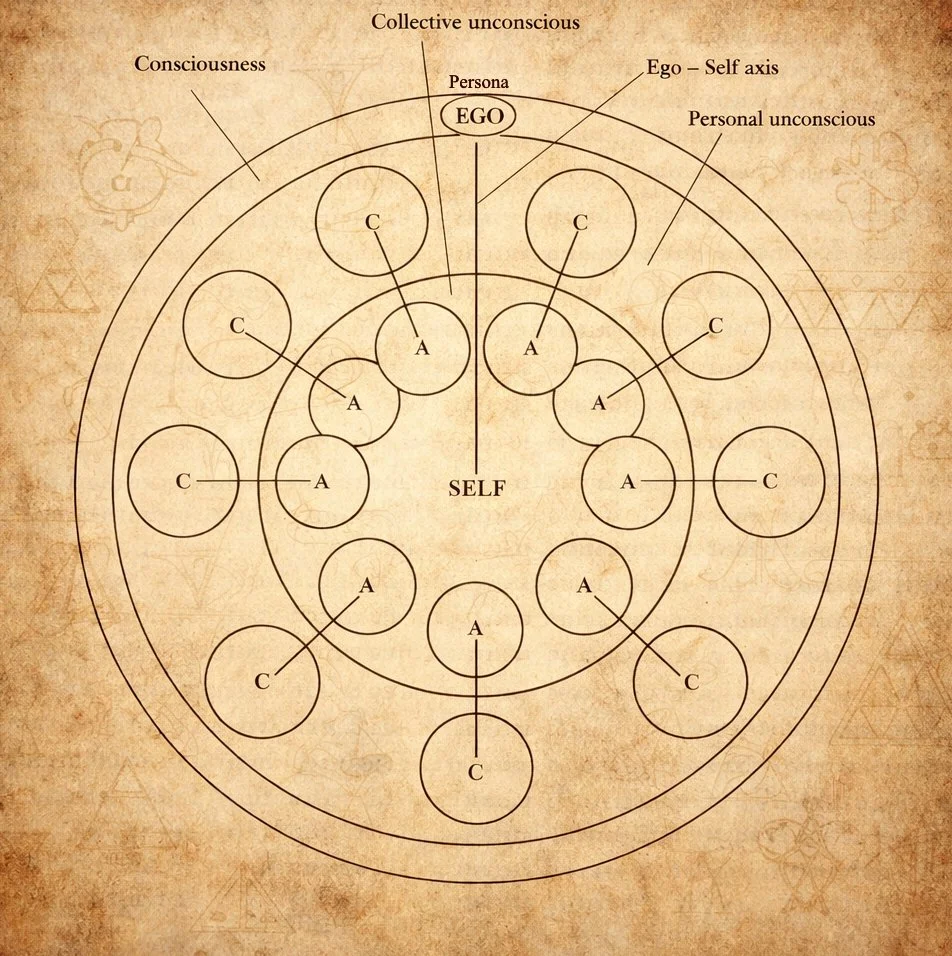
Below the ego is the personal unconscious with its active complexes, marked C. Below them is the collective unconscious which presents the archetypes that charge and orient the complexes, marked A.
At the very center sits the Self, the Imago Dei or image of God, connected to the Ego by the Ego-Self axis. In Jungian theory, the Self (with a capital S) does not describe the conscious ego but is a term that describes an organizing archetype that directs the psyche towards greater “wholeness” and destiny over the course of our lives. It also represents a spiritual locus within the individual that holographically mirrors the divine.
To better understand complexes we first have to grasp archetypes which are symbolic templates that influence our psychic patterning. Archetypes are meta-patterns that structure all of nature, including our bodies, minds and personalities.
Jungians often turn to myth and folklore to discover the ancient patterning of the human psyche, our instinctual behavior and the relationship dynamics that persist throughout all of time. Gods, goddesses and mythic icons like Jesus, God the Father, Mother Mary, Aphrodite, Persephone, Krishna or Buddha represent personified images of archetypes, which are foundational patterns that live at the base of the human collective psyche.
The role of complexes is to transform the patterning and energy of archetypes into ego consciousness, becoming our thoughts, feelings and behavior.
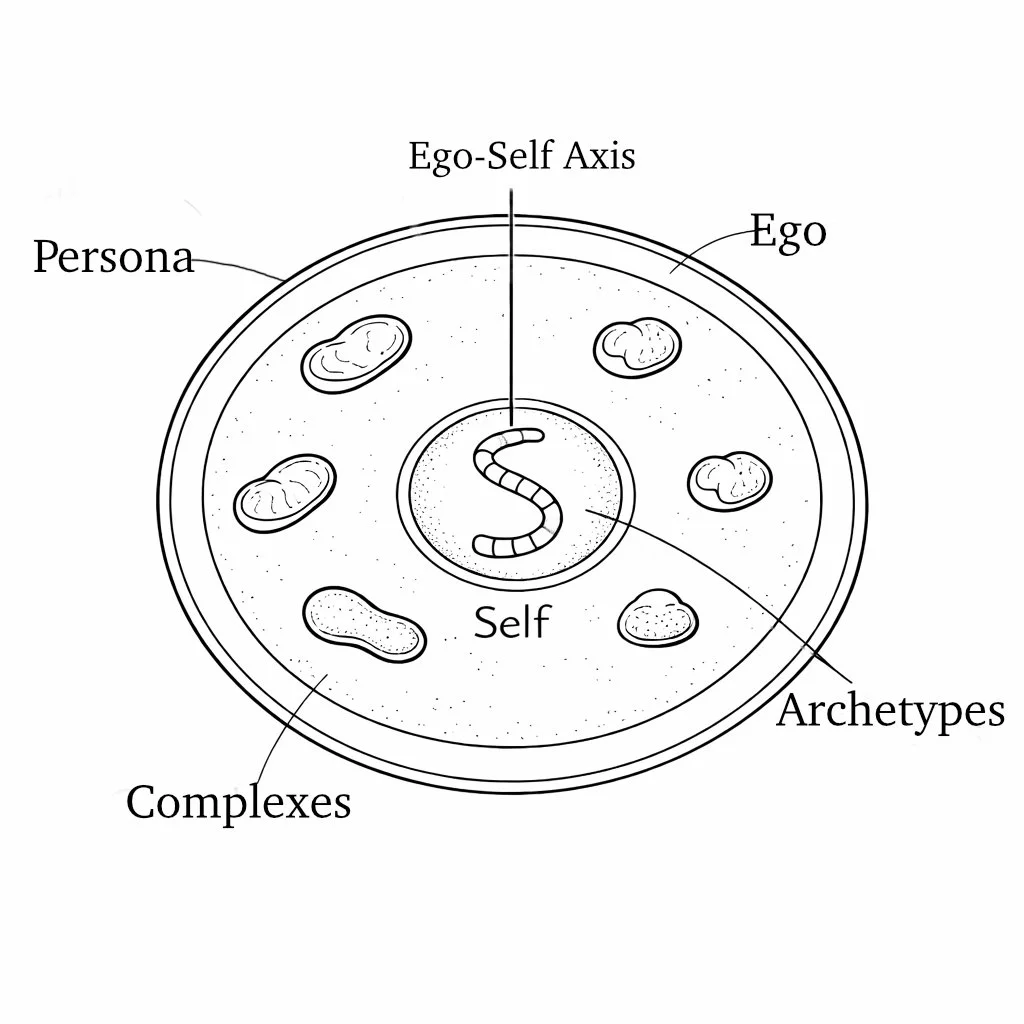
Now look at this next image. Here we see the psyche structured as a biological cell. The ego and persona are situated in the outer membrane. The central Self is the nucleus and the archetypes correspond to DNA. The cytoplasm is the personal unconscious and the complexes are the organelles metabolizing psychic energy and bringing it into the ego. When complexes become dysregulated, overloaded, or fragmented by personal or intergenerational trauma, their ability to metabolize and transmit psychic material can become impaired. Material may then remain partially unconscious, emerge in distorted form, or overwhelm the ego altogether.
Complex Details
Complexes are said to be feeling toned and organized around an archetypal core. For example, a mother complex draws its charge from the mother archetype and a warrior complex from an archetypal warrior pattern. When a complex that is tasked with directing a specific type of energy (for example warrior energy), is dysregulated it creates a spectrum of “shadow warrior” behavior from masochistic to sadistic. See Robert L. Moore’s book King, Warrior, Magician, Lover (1991) for more detail on the shadow manifestations of archetypes and the complexes that channel them.
Erel Shalit, in his book The Complex (2002) states: “The archetype does not determine one’s life course, and the actual experience is not shaped by a predetermined mold. To this end we need complexes, for they are the path and the vessel that give human shape and structure to archetypal patterns as they unfold in personal experience. The complexes provide the link between archetype and ego, enabling the transformation of the archetypal into the personal.”
Another useful analogy: archetype is to complex as grammar is to sentence. Grammar doesn't determine which sentences get spoken, but it defines the range of possible expressions.
Although what we describe below is the pathological activity of complexes, the overwhelming majority of complex activity is neither visible nor pathological. Complexes are working continuously, shaping the texture of our experience in ways that simply feel like mood, preference, attraction or aversion, the general feeling of a morning, a relationship, or a memory. When a complex is doing its job well it’s functionally invisible. We don’t experience it as a complex but simply as ourselves. We become aware of a complex mainly when it has broken into open conflict with the ego's regulatory function.
Complexes have us
Now let's move into the ways complexes can behave pathologically and distort conscious experience. When we talk about being “triggered” in common parlance, we are often talking about the activation or “constellation” of a complex, although triggering also occurs when ego based shadow is accessed. As we have discussed in many other works, the personal shadow is commonly projected out onto others and this causes so-called triggering as we identify our own shadow traits in another person. But affective, emotional triggering also occurs with complex pathology but in a way that is even more immersive.
When someone is triggered by an environmental event and is overtaken by what seems to be a different personality, then later says “I don’t know what came over me”, they are speaking of an autonomous complex. And when we look at the news today and see so many examples of human beings suddenly acting out criminally as if possessed by demons, we are talking about the activation of seriously pathological, trauma based autonomous complexes.
Once a complex is activated, it pulls experience toward itself. A core emotion floods our consciousness. Our perception becomes selectively filtered, our egos get flooded with confirming memories, and our emotional tone shifts into a preset direction. We get tunnel vision and become highly compulsive. Something has come over us.
A complex is also never purely psychological. Every activation is simultaneously a cognitive event, an emotional event, a somatic event, a behavioral impulse, and a relational expectation. John Sarno's work on psychosomatic pain pointed to how the psyche can displace unconscious emotional content into the body when it becomes too threatening to the ego. The body becomes the carrier of what the mind cannot bear to fathom. Take this into consideration when contemplating the sharp increase in physical syndromes and symptoms the population is now experiencing.
It is also worth noting that a complex becomes dangerous not only by being dysregulated but also by being denied. A complex that is known and admitted to, even a painful one, is already moving toward health.
Complexes can operate with semi-autonomy. They have characteristic triggers, generate predictable response sequences, can override conscious intention, and cycle in and out of activation independently of conscious will. This is what Jung meant when he said we don’t just have complexes, complexes have us.
The Relational Complex
A complex doesn’t always show up as an internal influence coming into personal consciousness. It often comes wearing the face of another person. What shows up in our heads during a relational conflict is the perception that something is wrong with another person that finally needs to be dealt with.
Let’s now look at an example of complex patterning that plays out constantly in close relationships. In this case, the complex is only mildly disruptive to life but extremely common. I’ll call the two people in this example Chris and Layla.
Chris and Layla have been getting to know each other for about two months. They’ve been hanging out together, calling, texting, having deep conversations and getting to know each other. Then one afternoon, seemingly out of the blue, Chris finds himself complaining about Layla’s texting. He’s noticed how long she sometimes takes to reply to him and he suspects she may not be reading all of his messages. He noticed this before but didn’t think it was a big deal.
Suddenly, it now feels urgent and his feelings about it are entirely out of proportion to the surface concern. That evening on the phone, he asks her if his messages have getting through and if she has her ringer turned on. Later, when trying to describe this moment, he says: "I don't know where this impulse came from exactly. It had just been building in me and suddenly I felt it had to be said."
Layla hears the complaint and feels herself tighten. Chris’ tone now sounds unfamiliar; something has shifted. She answers carefully but pulls back, less available, more measured. Her voice becomes more masculine. “Chris, I don’t feel like I have been avoiding you at all. I’m always just casual with my texting. I usually keep my ringer off for reasons of sanity. But I now feel like you’re pushing me, trying to control me.” Chris is self aware enough not to push it too far, but the conversation ends with Layla distancing herself from him and the two temporarily retreat.
From Chris's side, her withdrawal looks like proof of the very problem he was trying to pin down. Something in her is blocking their connection. From Layla’s side, his complaint looks like the first sign of a dynamic she has lived through before - a partner becoming demanding, moving towards control. In earlier relationships of hers, things like this had exploded tragically. She learned long before she met Chris that safety requires a certain distance.
The texting, of course, isn't the real issue. A relational complex has been constellated in the field between them, and the texting behavior is the innocent-looking vehicle it chose to ride in on.
Intimacy is what actually set off the complex. Relational complexes don't fire randomly. They activate when a relationship pattern starts to resemble the shape of an original wound, often related to closeness, dependency, or the need to be truly seen. The deeper the intimacy becomes, the more the present moment begins to echo the conditions that first caused the wound, and the more the old unhealed material gets stirred up and pulled to the surface.
A complex built around a relational wound runs on a damaged script, and when external conditions call on it, it runs that script again. Someone begins reaching too hard for the other, or pulling away too fast, unconsciously confusing the past with the present. What their developing intimacy revealed was already there in potential. Closeness didn't create it, it just brought it into view.
The surface grievance is almost always a cover story. The complex picks a stand-in issue such as texting, a tone of voice, or a missed call but the emotional wound beneath it is far older and carries far more psychological charge than the present circumstance. But the cover story isn't random. It resonates with the underlying wound. Complaints about reciprocity tend to point to old abandonment patterning. Complaints about autonomy tend to point back to parental emotional engulfment or control. We can also bring in attachment theory to explore different ways relational complexes perform.
For Chris, slow text replies confirm his old fear that when he reaches for someone, they won’t fully reach back. For Layla, Chris’ complaint confirms her old fear that closeness turns into pressure, then control, then something she has to escape. Both are reacting with full conviction to a wound the other didn't cause.
Each person casts the other into an ancient role. The person in front of you briefly disappears and an archetypal figure takes their place - the absent mother, the withholding or punitive father, the suffocating caregiver, the critic. Afterwards, when they come back to themselves, people often say some version of "I wasn't even seeing you." Until the complex releases its hold, one’s perception is overtaken by the complex’s own projected “movie”.
Importantly, the two partners’ reactions to each other are actually one movement. The complex lives equally between them. With most relational complexes of this type, one partner reaches and the other keeps their distance. One attacks, the other protects in a bipolar victor-victim cycle. These look like opposite behaviors, but they are two sides of a single process. Two psyches are working through an intimate connection that has become deep enough to stir up old material that a dysregulated complex is mediating.
Neither partner is the primary problem. Both partners are involved completely. Both partners have a complex, or a “pain body” in Eckhart Tolle’s words. Both partners have exiled and protective “parts”, in IFS terms. And they will always create relationships with these dynamics until they dig up their complexes. They either consciously work though these dynamics or continue to play out the complex scripting chronically throughout life. And when you see this same dynamic playing out in entire populations who are involved in tribal or nation-state level conflicts, you now can see where this all comes from. This is playing out en masse throughout the collective human psyche.
The way through this is not to try to shut the complex’s activation down, and it’s not to defend the complex’s scripting as if its version of reality is objectively true. It's to keep the container of relationship intact, notice that something much older has been activated and ask “what part of me, and what part of you, is getting fed by this conflict?”
Working through our complexes is the price we must pay for deep intimate relationship. As we deepen intimacy, the wounds we carry finally get close enough to the surface to be seen, and if both people can stay in the room and can apply some psychological lenses and tools, these wounds can finally be worked with. When you’re in the alchemical vessel of deep relationship and it starts to get hot, if you break the container the alchemy stops. To succeed in the Work, you need awareness of what’s going on, tools of the trade, great sensitivity and real courage to use the activation of a complex to go into the old wounds so they can get aired out and their emotional content integrated.
See my books Transforming Darkness or Shadow Tech, both of which have descriptions of what we call emotional processing that you can use to integrate emotional material after the activation of a relational complex. And as mentioned earlier, look into the Internal Family Systems model.
Extremely Autonomous Complexes
The story above was an example of the activation of a relational complex that’s mild within the spectrum of intensity. Now imagine every horrific example you have seen in the news or on the internet of a ruthless murder on a subway, or a school shooting, chronic domestic violence or countless other examples we see almost every day now of people getting “taken over” by some autonomous complex that compels them to do things that they normally wouldn’t do. These are examples of the movement of ancient primal energies that every human has within, being dysregulated by a traumatized complex and flooding their ego. For a moment, that person becomes a horror movie character, they become a shadow archetype - the Joker, Jack the Ripper, the Evil King or Queen - and those ancient scripts usurp and circumvent their conscious egos.
In very severe cases, when these complexes are able to gain regular access to consciousness, the ego identifies with the complex and allows it to become them in total. Now the personality is the complex. This is complete possession. But in most cases, these complexes are only slightly or somewhat traumatized and can only gain occasional access to the ego. Road rage is the perfect example of this. But so is the guy who always gets into fights at the bar or the woman who continually gets into abusive relationships. Same goes for the long term addict or even the individual with chronic pain or psychosomatic symptoms. All are examples of the influence of autonomous complexes created by personal and intergenerational trauma.
We often look at people who are acting dysfunctionally and ask what is wrong with them. But there are more entities involved in all these decisions than just the man or woman we are trying to understand. There’s a larger community or family of complexes infiltrating the ego.
Traumatic Origins of Dysregulated Complexes
How and why do our complexes break down or become autonomous?
Early life trauma, where a child cannot process or find appropriate meaning for a highly stressful event or environment, leads to the psyche compensating in makeshift ways and dissociating. In dissociation, parts of our psychic network of complexes get split off or exiled, we might say. The psyche heals itself the best it can, but now the proper transformation of archetypal patterning into healthy expression is thwarted. The resulting pathology manifests across a spectrum from mild to severe. Most moderns have some level of internal splitting, which fractures our complexes and can lead to all kinds neuroses, compulsions, addictions, personality disorders, relational conflict and so many forms of pathological states of consciousness and behavior.
From Shalit’s The Complex:
“External events may, however, be too traumatic, breaking through ego-boundaries and defenses, as is the case for instance in child abuse. The traumatically caused autonomous complexes that constellate in abused children are not “potentiating wounds” but carry concrete scars, which divert energy from the ego and hamper development. In fact, as [Pierre] Janet had proposed, the autonomous complex is sometimes constellated “as a defense against the anxiety caused by traumatic experiences.” And Jung clearly speaks about the autonomous complex when he says that they are “psychic fragments which have split off owing to traumatic influences or certain incompatible tendencies.” A complex becomes autonomous when the ego rejects it, for example by splitting, denial or repression. When the ego prevents it from entering into consciousness, or expels it therefrom, the complex becomes pathological.”
Ego Based Shadow vs Complex Pathology
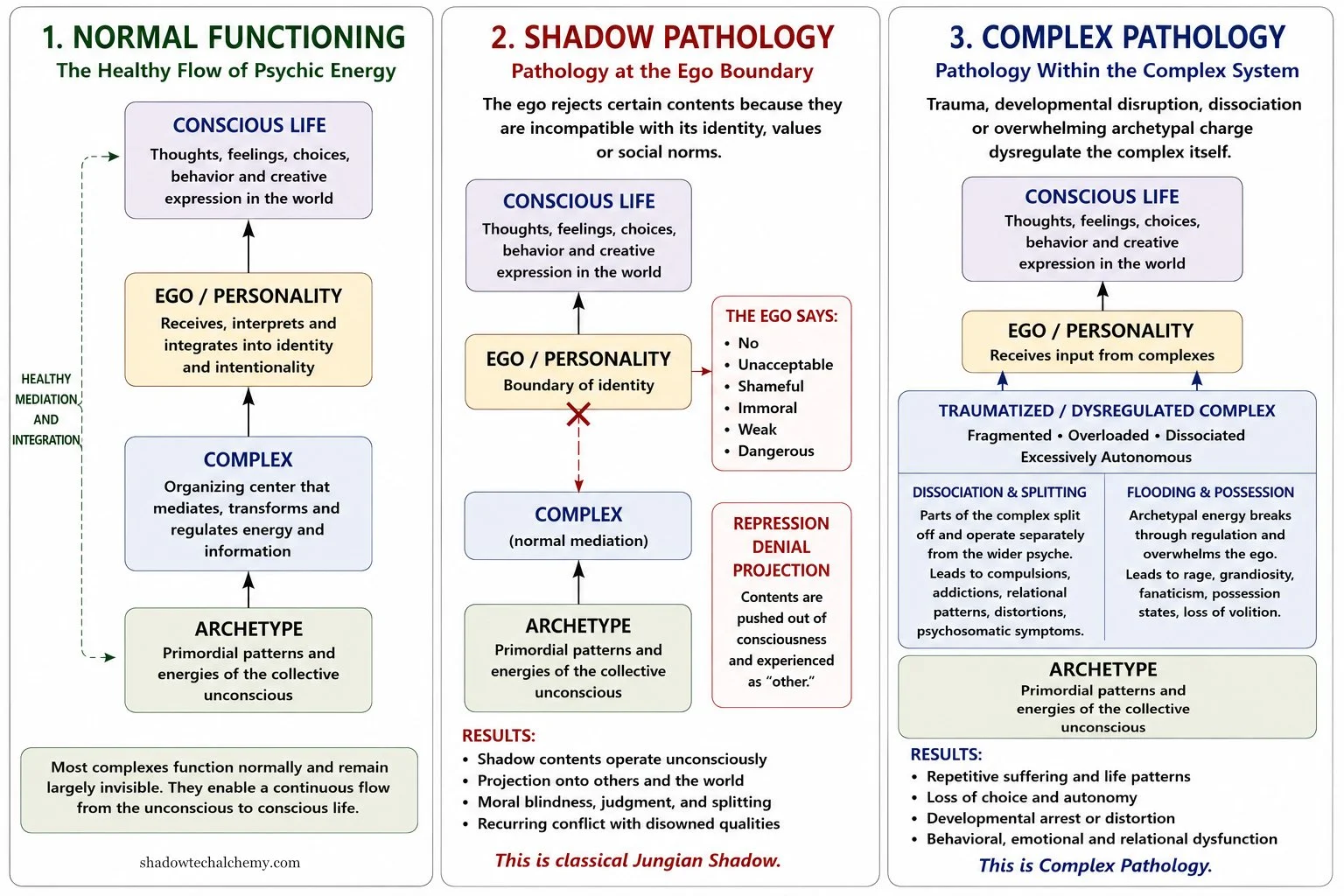
See the image at the end of this article
Shadow pathology and complex pathology are not simply two different problems. They are deeply entangled and in ways that are difficult to separate. Ego based shadow arises when the ego refuses conscious relationship with aspects of the psyche that it finds threatening, shameful, immoral, or incompatible with its preferred self-image. Through suppression, repression, denial and projection, these qualities are pushed out of conscious awareness and continue operating unconsciously. The result is moral blindness, triggering, compulsive judgment of others, and the tendency to encounter in the world that which we cannot recognize in ourselves. Projection is perhaps the most common expression of this: the qualities we cannot consciously own appear to belong to other people, and we experience them as obvious flaws, dangers, or sources of fascination. Shadow pathology is primarily a disturbance in the relationship between the ego and the psychic contents it disowns due to familial, cultural and social incompatibility.
Complex pathology has its own origins. A complex loses its capacity to mediate psychic energy in a balanced way when it has been traumatized by difficult life experiences, especially in childhood. When a complex begins operating autonomously, it generates recurring emotional reactions, compulsive behavioral patterns, somatic symptoms, relational conflicts, and chronic forms of suffering that persist despite conscious efforts to change them. When an autonomous complex is “constellated” it possesses the ego and biases the individual’s internal perception into an immersive “movie” of its own, according to a personalized, but archetypally rooted script. In severe cases the complex floods or possesses the ego entirely, producing possession states, ideological fanaticism and destructive episodes.
The relationship between shadow pathology and complex pathology is related, but in a nuanced way. This is why the distinction between shadow and complex activity is often blurred in the literature, and why we have found the boundary difficult to determine.
From what we can currently discern, ego-based shadow projection operates in humans without any influence from autonomous complexes needing to be part of the equation. Psychic material such as rage, sexuality, control drives, grief and all antisocial material will commonly be denied, repressed and projected. No autonomous complex is needed. But with that said, otherwise healthy complexes will be involved in the salience and emotional power that accompanies classical shadow projection. When one is projecting their own narcissism onto another, for example, a complex will be part of the emotional power of that projection and one’s sense of disgust.
One the other hand, autonomous complex activity, while being a different psychic phenomenon with different causes than classical shadow projection, is itself intimately related to shadow dynamics. The distressing psychic material that was part of the original wounding that caused an autonomous complex to form remains inaccessible to the ego, making it shadow material by definition. So the projection of unwanted traits classically referred to as shadow projection is not dependent on autonomous complexes, but autonomous complexes and their related material is caught up in the same defense mechanisms that ego based shadow is. This is a nuanced relationship that may have little consequence in practice, but which our research pursued for the sake of clarity.
In terms of shadow work, ego based shadow material calls for the individual to expand their capacity for self-awareness, to withdraw projections and acknowledge what they have disowned. Complex pathology calls for the healing of wounded inner structures that have lost their capacity for healthy regulation through depth psychological methods, inner parts work, somatic work, relational analysis and repair, and the slow integration of split-off material by re-relating to it holistically. These are distinct but related tasks, and in practice they often become the same work. Acknowledging culturally deprecated states of being (ego based shadow) and healing dissociated complexes tends to happen together.
This concludes our present examination of complex pathology and the relationship between autonomous complexes and ego based shadow. I hope this paper can help bring more clarity to the subject of human darkness, the shadow and shadow work in general from a Jungian perspective.