The Shaman and the Sacred Artist
The Shaman and the Sacred Artist
Discovering the spiritually initiated artist and their connection to shamanism
PDF version here
By Colin E. Davis
shadowtechalchemy.com
August, 2026 v 1.1
We aim to understand the origin of the spiritual or Sacred Artist and their relationship to the Shaman. The Shaman is the ancient compound role of those who, among other things, healed, initiated and transmitted the sacred for a tribe. Over time this single role split into many narrower ones such as priest, doctor, scientist, scholar, teacher or artist, most of which have become secular in the modern world and drained of their spiritual essence. This paper first discusses the reasons Shaman existed, the multiple ways their work was carried into the world, and the initiatory life experiences that create and charge their role. Then we explore the spectrum of artistry and the Sacred Artist, who transmits spiritual gnosis through the medium of art and how they relate to the Shaman. Finally we describe the Sacred Life Art of the author and his late partner, Melissa Mari.
Why the Shaman Exists
The ancient Shaman grew from a set of needs every community has which require “special” knowledge, experience and capacities. The Shaman is a compound specialist, but essentially they are a psycho-spiritual and cultural technician. Within the Jungian framework, we might say that they are highly charged by the magician archetype. Every human has some of the skills of the Shaman, but they were the ones who performed them together and with depth.
Seven Roles of the Shaman
Here we simplify the roles and functions of the Shaman into seven related but distinct categories.
Healing - Restoring health and wholeness in the body and mind.
Initiating - Assisting people at the great thresholds of life - birth, coming of age, psycho-spiritual crisis, death, and helping them understand life’s meaning, lessons and paradoxes.
Revealing - Perceiving what is hidden from reality, reading signs and symbols, seeing into the personal and collective psyche, and interpreting what is concealed.
Mediating - Communicating with unseen powers, spirits, ancestors and external forces, however a people understood them.
Sacralizing - Tending to the sacred for the community through ritual and sanctification of holy things.
Innovating - Bringing in new inventions, ideas and practices a community needs to evolve.
Mythologizing - Feeding the living imagination of a people with fresh contact, keeping the guiding stories alive through art, oral and written transmission.
The Roots of the Shaman’s Role
At the root of a Shaman’s role and practice was always their own twice-born initiation. This means that those who grew into the Shaman role were those who suffered their own near-death experience of some kind and returned back to the world fundamentally changed. This may occur by way of a physical near-death experience, and/or a psycho-spiritual one which is sometimes called the “dark night of the soul” or a “spiritual emergency”. In other cases they experience spontaneous or triggered awakenings of consciousness that fracture their normal waking state of reality and alienate them from normal life and community.
In optimal situations, people who suffer from such crossings are assisted by Shaman to understand their experiences and then reintegrate themselves back into society. They do not usually become Shaman proper. But those who naturally have the in-built capacities to do so, may use their experiences and special perspective by becoming Shaman themselves or performing a related sacred role. Because the psyche requires relational mirroring to integrate transformation, initiation into a shamanic or sacred role requires the influence and assistance of others with experience who see this capacity in the individual and help to initiate them into their work.
Four Quadrants of Shamanic Practice
To fathom the holistic role of the Shaman, it’s helpful to see it through Integral Theory’s four quadrant lens. This model makes clear the four primary ways human beings experience their world. We experience life internally through the lens of our own personal psyche. We also experience life interpersonally through culture and the relational field. We do so physically through the body and its behavior. And we experience collective life through the social structures that we build and live within.
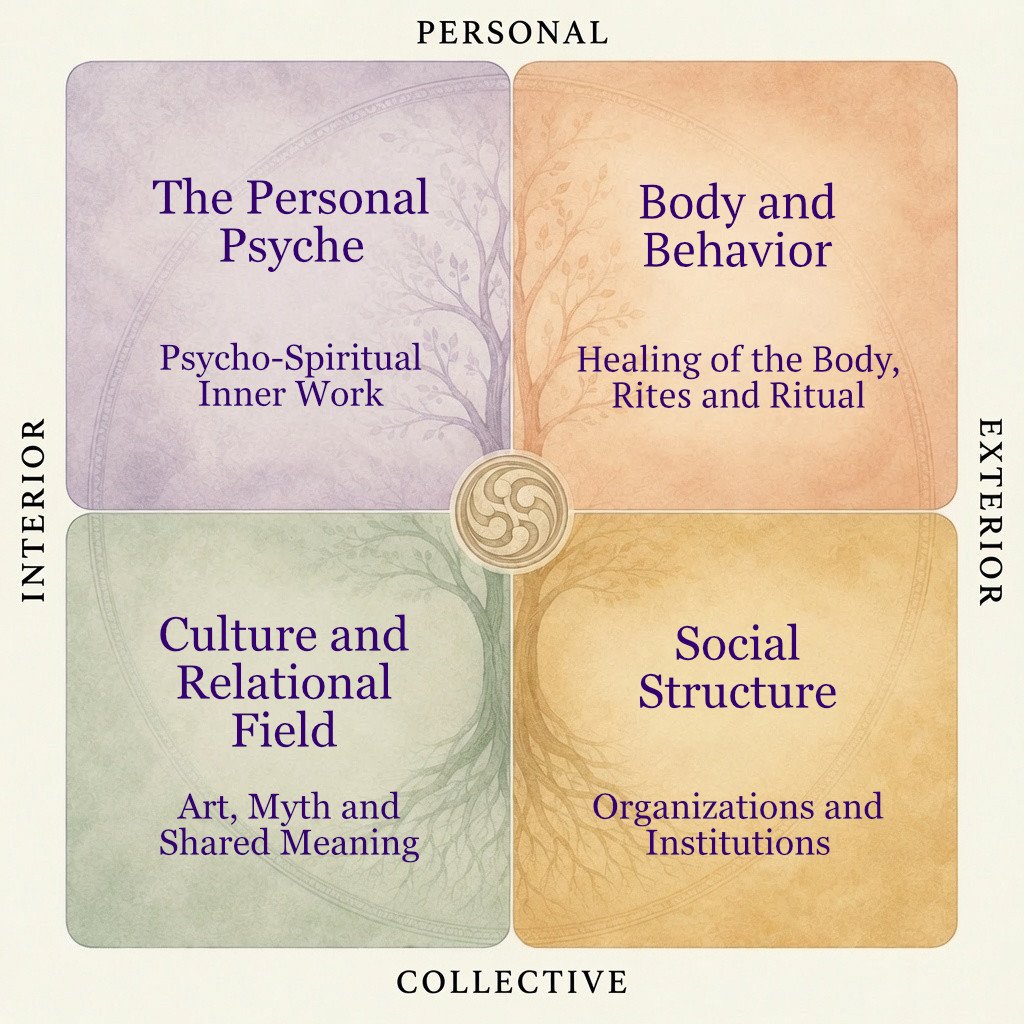
When this map is applied to the Shaman we can see the total profile of Shamanic practice and we can also use this model to see the locations of the many “sacred specialist” roles. Let’s first zoom into each quadrant of the Shaman’s experience to get a clearer picture.
The upper left hand quadrant of the map covers the inner space of the psyche. This is the domain where the Shaman works on themselves. This quadrant covers their own descents into the depths of their unconscious, the facing of their own shadow, and the healing of their own wounds. A person cannot guide another through territory they have never walked, so the domain of inner work comes first. Their experience with the depths of the psyche come from their original twice-born initiation and/or recurring plunges and their life-long inner investigative work.
The lower left hand quadrant works with culture and the inter-relational field, where their work is carried through art, story and symbol and also the beliefs, attitudes and shared psychological states between people. This domain of work can reach the furthest, because cultural attitudes, information and symbols can travel far across distance and time.
The upper right hand quadrant is the domain of the body and physical behavior. Here the Shaman’s work extends into bodily healing and into all behavior, physical ritual and ceremony.
The lower right hand quadrant covers the domain of social structures, where the work is carried through the lasting communal things a people make together - their organizations and institutions, temples and lineages. Always, a sacred source sits behind those structures, giving society its spiritual foundation. Or at least until such a society degrades and loses contact with the sacred, in which case, the shamanic function must find its place of influence again before the society returns to health.
The Sacred Specialists
As was mentioned above, the secular modern world still uses the skills of the Shaman but they do so through specialists who preach, teach, heal, invent or artify the world, although the sacred initiatory core is to a great degree absent. And while there are modern instances of the Shaman proper, mainly what we see today are sacred specialists who embody one or more of the Shaman’s several roles. But because of modern society’s desacralized condition, even the sacred specialists may have a difficult time owning their spiritual talents and finding a functional social role that utilizes them.
If we use the Integral map, we can somewhat isolate different types of specialists, although they blur into each other. Most roles will have a primary function in one quadrant and additional functions in others. The following will be a short and limited list, but see Andrew Camargo’s “25 Facets of the Shamanic Archetype” for a detailed exploration of many types of shamanic specialists.
Those who primarily work with the unconscious mind may operate today as therapists, spiritual healers, alchemists, empaths, tarot readers, astrologers or anyone whose work is about discovering and working with the contents of the psyche. Those who work with culture and the inter-relational field often operate as teachers, speakers, creatives and artists of all types. Those who work with the body act as medical specialists and bodily healers. Yogis, body workers, martial artists and dancers clearly bridge the body and mind quadrants. Those who work with social structures may act through local community building and the development and maintenance of new systems, organizations and institutions.
Due to the fact that the shamanic or sacred roles are obscure and esoteric in the modern world, formal apprenticeship and cultural role initiation is often absent or partial in their lives. But because of the psyche’s inbuilt need for relational mirroring, and our natural inability to see ourselves objectively, the sacred practitioner benefits greatly from the help of peers, elders and sometimes through intimate “alchemical” partnerships.
And this brings us to the point that nether the Shaman nor the sacred specialist just appear fully formed and matured by way of personal and relational initiations. Their qualifications only begin with their initiations. To initiate means “to start”. Competency comes from experience doing their own personal and relational inner work and from working with many others. The one with special knowledge can be as dangerous as they can be helpful. And the Shaman proper is not a true Shaman if they use their knowledge and experience in an imbalanced or shadow tinted way. The true Shaman is not a Sorcerer. The one with a sacred mission has the highest ethical duty to engage in personal shadow work continually and as deeply and seriously as anyone, anywhere. The ego inflated, shadow bypassing guru or sacred spiritualist who gains a following is a true danger to themselves and their community.
Also, do keep in mind that we are using titles and identifications here for mapping purposes only. Using a title as a social persona script may be useful, but you don’t want to closely identify with a title that cannot possibly hold the depth and diversity of one’s practice or the human being behind it. Persona identification always creates shadow.
Sacred Artistry
The artist is the specialist of the domain of culture and shared meaning. Art is a carrier of culture-mind, the ecosystem of personal and collective psyche. Art has collective and personal functions covering both left hand quadrants in our map. The first function is symbolic communication - the passing of meaning from mind to mind through all artistic mediums - visual, auditory or written. The other function is psycho-spiritual catharsis. This means accessing, releasing and artifying psychic material through a medium for personal psychological benefit.
The creation of art is like a cultural digestive process. Humans take in the stuff of mind and culture, digest it, internally reform it, then push it back out with their own creative modifications that the society can use to see, understand and develop themselves.
We have noticed that the modern day artist varies widely in terms of their relationship to the sacred. The most secular artist may have no conscious intent to use art as a spiritual function. Regardless, even the most secular artist is still transmitting sacred qualities in their work. This is because they are always influenced by other artists who do have a spiritual orientation; because the symbols and images they work with are collective and therefore have spiritual influence embedded within them; and because all people are in continual relationship to the unconscious which influences everything they do. But this aside, we might see the fully secular or corporate artist as being on one end of a spectrum and the shamanic or Sacred Artist on the other.
As an artist becomes more aligned with their own shamanic functions, their art becomes more oriented towards healing and awakening. As they progress in this direction, they become more conscious of what they are doing and they increasingly imbue their art with meaningful symbolic and spiritual essence, knowing that their work is stimulating the psyches of those who experience it. Some place their practice into a special compartment in their lives while others bring their artistic way of thinking and being into multiple areas of their lives. Melissa Mari identified the Life Artist as one whose artistic way of seeing and being is totally integrated into their reality. Their entire life becomes a work of art.
The Sacred Artist does in the domain of culture what the Shaman does though all seven or more shamanic functions. Sacred Art can heal, reveal, mediate, innovate, point to the sacred and the new, and carry forth orienting symbol and narrative for a culture. But the medium of art has the advantage of exponentially wider influence. A symbol travels much further than physical touch, across vast distances and time. So the Sacred Artist's work reaches people they will never meet and it outlasts the artist’s own life. Sacred Artistry, when mature, is collective shamanic practice of the highest order.
The Sacred Life Art of Colin and Melissa
The reason why this examination of the Shaman and the Sacred Artist was conducted was to be able to map and place our own artistic way of being. Here we will use our own example to illustrate one couple’s practice of Sacred Life Art.
This author and his late wife, Melissa Mari, were professional musicians and life long spiritual seekers. I had experienced one big dark night of the soul eight years before we came together and she had a notably “Persephonic” life, experiencing many underworld trips during her time. Then, together, between the years of 2013 and 2025, we partnered in a loving, highly creative and psycho-spiritual relationship that served as an “alchemical vessel” for our continued inner development and the creation of multiple forms of Sacred Art.
In our case, much of our work was focused on understanding and mapping the shadow side of the psyche, both collective and personal. We “practiced” by way of conversational jams, like how musicians create songs, until we had channeled an entire “set” of psychological, philosophical and metaphysical concepts that served as the basis for our own alchemical life practice. We released the first set of creations in a book called Shadow Tech, published in late 2015.
In the background, we were studying the Jungian Way and other psycho-spiritual systems, and we were engaged in deep shadow work and self examination. Our relationship and creative process became highly numinous and synchronistic as we reached more deeply into our own psyches and the relational field between us.
Starting in 2014, we began putting this material into music and building an “alchemical” rock band called The 01Experience. The name was rooted in the metaphysics of duality which was part of our work and related to Melissa’s first band called One. We used this band as a musical vehicle for our ideas which were enshrined tonally and symbolically into the music, lyrics, on-stage visuals and theatrics. Melissa was a singer and performer of the deepest, spiritually connected variety.
Also embedded into the music was our own mini-myth, the story of Will and Faith, the alchemical couple, based on our own lives. These names pointed to the sacred masculine and feminine, animus and anima, and other spiritual principles.
All the while we documented our inner development, ideas and art process on video and audio tape. We recognized early on that what was happening to us was rare. We also noticed the way our lives were unfolding in a mythic and movie-like manner. The countless synchronicities and epiphanies that showed up in our movies of life were like breadcrumbs that when analyzed with symbolic awareness, revealed story elements and an ongoing narrative structure or script that was running through us. We called this realization Living in the Movie. We also realized that this awareness of the movie-like nature of reality was simply a restatement of the most ancient mystic awareness of the dream-like or simulated nature of human consciousness.
We built a detailed metaphor to describe Living in the Movie and we continued to develop it for years. Once one accepts that reality and life is largely manufactured by our own psychic projections and that the film which encodes those projections is within our own psyches, what can you do with this? Can you become the director, or at least co-director of your own movie of life? And even if that is not fully possible, you can certainly improvise and consciously play within your own movie of life.
We eventually realized that while you can get involved in the projection process and you can modify the emulsion on the film, there are core narrative structures that cannot be altered. This is our fate. Our job is to manifest our destiny, which may depend on awakening and developing our psyches, but fate will always take what it will. We must manifest our destiny, despite our fate. How much we can be involved in the process is unknown. But we were actively engaged in this experiment and I still am.
Part of Melissa’s fate was to leave this planet at age 62. That was written into our movies. It was that occurrence that showed me that the movie has plot elements that are sealed because we worked very consciously on this. But what was achievable, and what was accomplished, was the awakening of our consciousness and the experience of being conscious Sacred Life Artists. And our creations and experiences are enshrined in artifacts for posterity and that is one of the most special things about artistic shamanism.
We matured inwardly in ways that never would have occurred had we not focused ourselves on the inner work. That inner archeological work, and the Will and Faith it took to go into our own shadows was what activated the alchemical vessel of our relationship. And it’s what gave our movies of life highly charged, mythic and meaningful qualities.
After Melissa’s passing, while deeply grieving the loss of my soul mate and experiencing my second twice-born initiation, I worked with the documentary footage we collected over the years. We long knew that we were going to make a physical movie and we assumed this movie would relate to the Life Art practice of co-directing one's movie of life. But I had no way to know that I would have to make the movie after she was gone. In late 2025, I finished the film “Melissa Mari: Musical Alchemist of Stage and Psyche” to showcase Melissa’s powerful shamanic musical art, her way of being, and our time together. And now I continue to develop and release our Sacred Life Art as new books, movies, music and art of many types.
I say all this here to illustrate what Sacred Life Art can look like. Every Life Artist will have their own movie of life and will manifest their own creations. Your Life Art will not look like ours, but it can be just as numinous and valuable. What matters is that every artist who channels their deepest spiritual substance, gained through their own initiations and trips into the unconscious, is engaged in shamanism to some degree. Shamanic art first heals us the creators, and then it re-sacralizes the entire world around us. When many of us engage in the creation of Sacred Art, and when we do it as deeply and passionately as we can, together we actually heal the human race.
This is what Melissa always knew and what she always did from her earliest days, because she was initiated early on. And it’s what I learned to do from watching her. She always said these things even before I had sophisticated ways of putting it. All I am doing here is making sense out of what she always knew.